
Stir-Fry Fundamentals: The Order of Operations
Every stir-fry follows the same seven-step sequence. Learn it once and you can cook most Chinese dishes without a recipe.
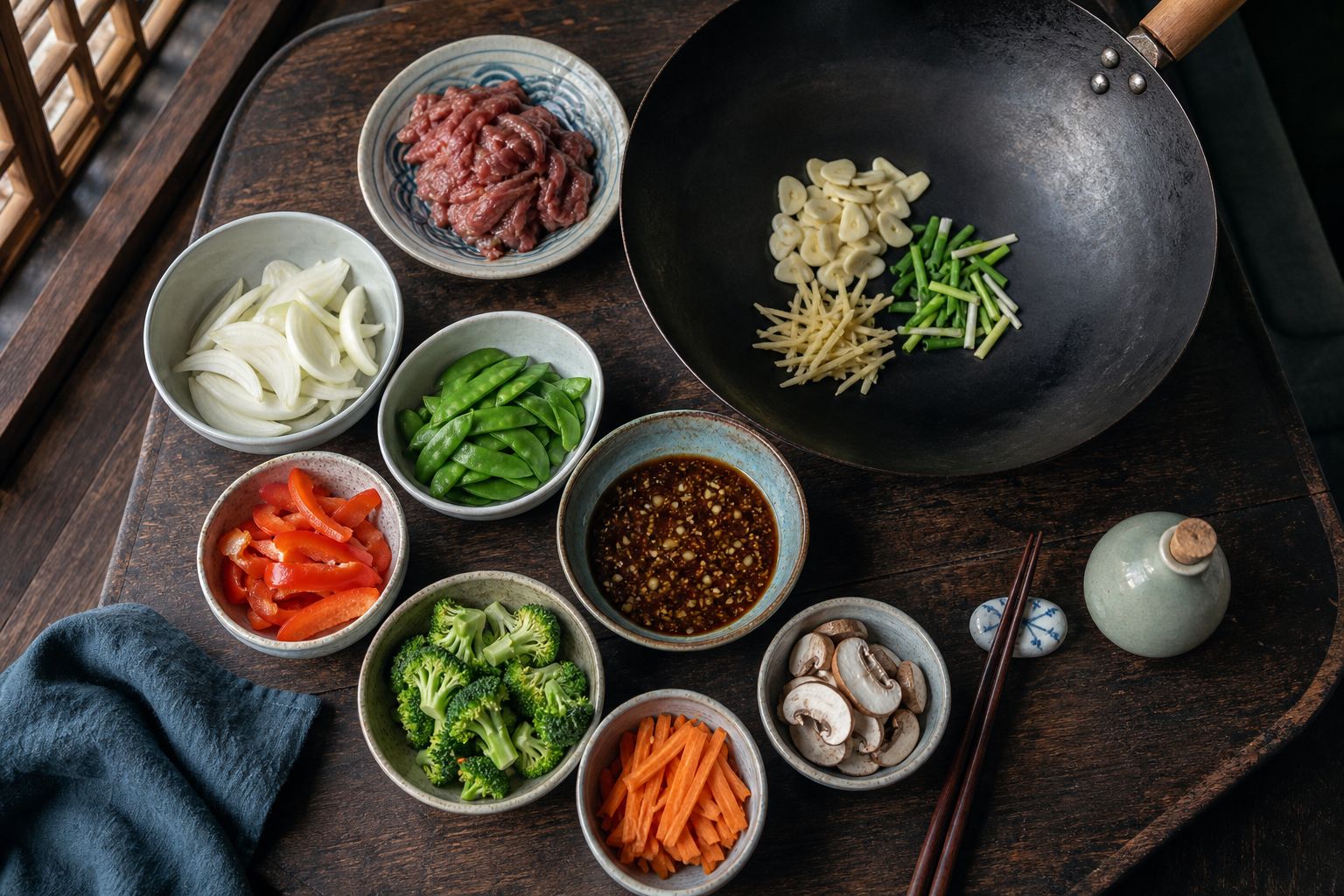
Almost every stir-fry on this site — and most of the ones you will eat in a Cantonese restaurant — follows the same sequence. Once you internalize it, recipes stop being instructions and become variations.
The sequence
1. Prep everything first. All of it. Cut, measure, mix the sauce, and put each component in its own bowl beside the stove.
This is non-negotiable in a way it simply is not in Western cooking. A stir-fry runs for three to five minutes with no pauses. There is no moment where you can go mince garlic. If you are still chopping when the pan is hot, the dish is already compromised.
2. Heat the wok dry until it smokes. Two to three minutes on your highest setting, empty. Almost every failed home stir-fry failed here.
3. Add oil and swirl. It should shimmer and thin out immediately. If it just sits there, the pan was not hot enough — take the oil out and start over.
4. Aromatics, 15 to 30 seconds. Garlic, ginger, scallion whites, dried chilies. They go in briefly to perfume the oil. Garlic burns in under a minute at stir-fry temperature, and burnt garlic makes the whole dish bitter.
5. Protein, in batches, mostly undisturbed. Spread it in one layer. Leave it alone for 30 to 60 seconds to take on color, then stir-fry until just short of done and remove it from the pan.
Crowding is the most common mistake in home cooking. Half a pound at a time in a 14-inch wok. Two batches always beats one crowded batch.
6. Vegetables, hardest first. Carrot and broccoli need two to three minutes; peppers and onion about ninety seconds; leafy greens and bean sprouts under a minute. Add them in that order rather than all at once.
7. Combine, sauce, and finish — under 60 seconds. Return the protein, pour the sauce around the rim of the wok so it caramelizes on the way down, and toss until it thickens and coats. Kill the heat, add sesame oil and scallion greens, and serve.
The rules underneath the sequence
Dry ingredients brown; wet ingredients steam. Pat meat dry. Drain vegetables properly. Any surface water has to boil off before browning starts, and boiling it off is what drains the heat out of your pan.
Cut everything to a uniform size. Not for looks — for timing. Mixed sizes mean some pieces are raw when others are overcooked.
Sauce goes in at the end, and it goes around the edge. In the middle it just pools and lowers the temperature.
Undercook the protein deliberately. It returns to a hot pan and finishes there. Cook it fully the first time and it is dry by the time it reaches the plate.
Serve immediately. A stir-fry has a shelf life measured in minutes. Have the rice done and the bowls out before you start.
Practising it
Make Tomato and Egg Stir-Fry three or four times. It has almost no ingredients, so there is nothing to hide behind, and it teaches you exactly how your pan behaves at temperature. Once that feels automatic, the sequence above will carry you through most of the recipes here.
What we use
The specific equipment and ingredients behind this guide.
- Small prep bowls
A stir-fry runs for four minutes with no pauses. Everything has to be measured and within arm's reach before the pan gets hot.
- Wok spatula (chuan)
Scoops along the curve of the wok instead of pushing across a flat surface.
Keep reading
- What Is Wok Hei — And Can You Get It at Home? The smoky 'breath of the wok' that makes restaurant stir-fries taste different. What actually causes it, and how close a home stove can realistically get.
- Velveting: Why Restaurant Chicken and Beef Are So Tender The Chinese restaurant technique behind silky stir-fried meat. Three methods, when to use each, and why baking soda works on cheap cuts.
- 12 Chinese Pantry Essentials Worth Buying The sauces, vinegars, and pastes that unlock most Chinese recipes. What each one does, what to buy, and the three you can skip at first.