
What Is Wok Hei — And Can You Get It at Home?
The smoky 'breath of the wok' that makes restaurant stir-fries taste different. What actually causes it, and how close a home stove can realistically get.
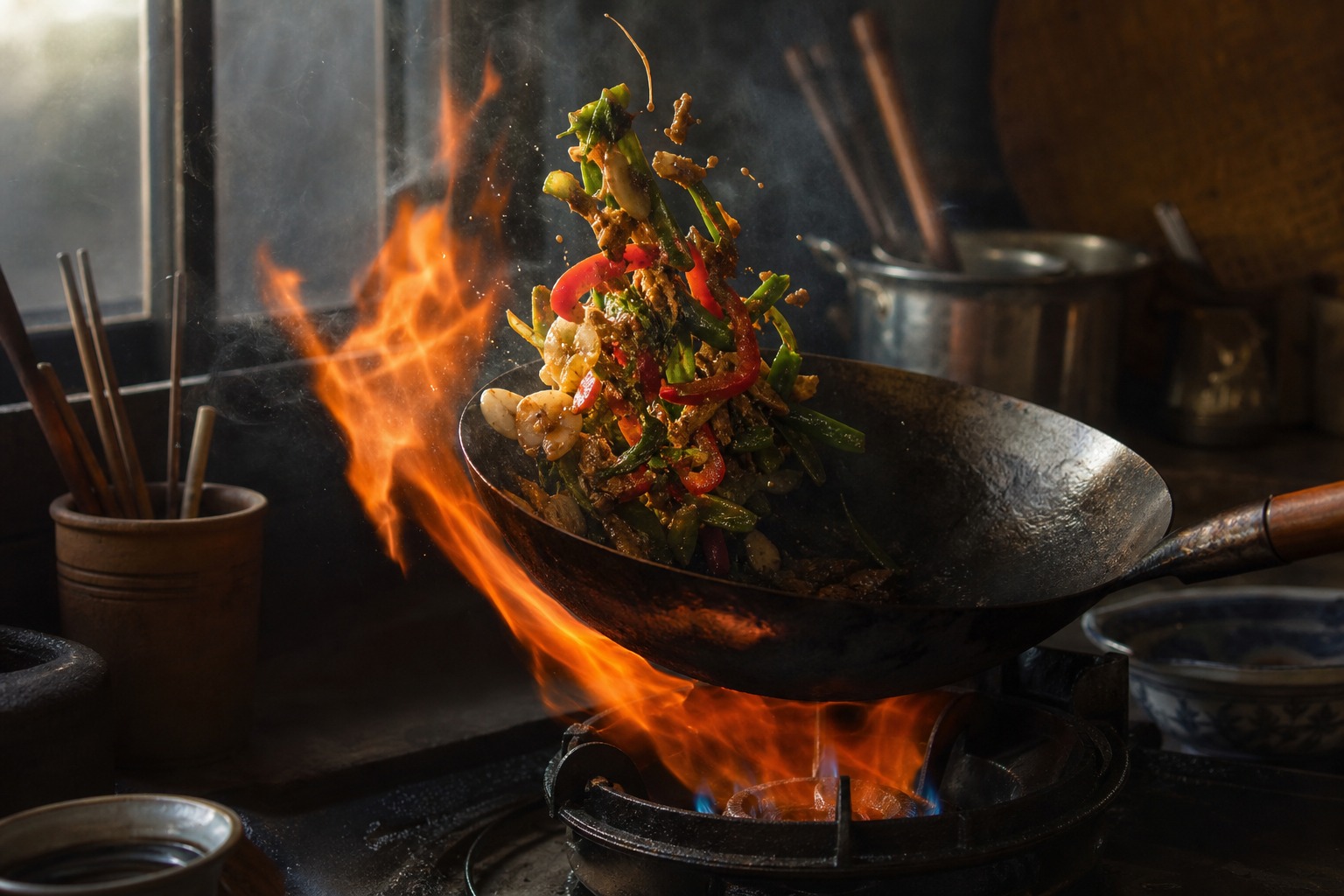
Ask anyone why their home stir-fry does not taste like the one from the Cantonese place down the street and the answer usually comes back as one phrase: wok hei. It is Cantonese for “breath of the wok” — the faintly smoky, savory aroma that clings to a properly cooked stir-fry and vanishes within minutes of it leaving the pan.
What is actually happening
Wok hei is not one thing. It is at least three, all happening at once:
Maillard browning at very high temperature. Proteins and sugars on the surface of the food react and produce hundreds of new aromatic compounds. This is the same reaction as a seared steak, just faster and across more surface area.
Oil breaking down and reacting with food. At around 400°F and above, the cooking oil itself begins to decompose and react with what it touches. Some of the compounds produced are unique to that reaction and are a major part of the smell.
Actual combustion. When oil aerosolizes and hits an open flame — the moment a restaurant cook tosses the wok and a fireball appears — it burns briefly, and those combustion products land back on the food. This is the part home cooks genuinely cannot fully reproduce on an electric range.
The uncomfortable truth about home stoves
A restaurant wok range runs somewhere between 100,000 and 200,000 BTU. A good residential gas burner is about 12,000. That is not a small gap and no technique closes it entirely.
So: you will not get full restaurant wok hei on a home stove. Anyone who tells you otherwise is selling something. What you can get is 70 or 80 percent of the way there, and the difference between that and where most people currently are is enormous.
What actually helps
Preheat the empty wok until it smokes. Two to three minutes on your highest setting, dry. Most home stir-fries fail before any food goes in, because the pan was merely hot rather than genuinely ripping.
Cook in small batches. This is the single highest-impact change. A pound of chicken dropped into a home wok crashes the temperature 200 degrees and everything steams. Half a pound at a time cooks; a full pound stews.
Dry your ingredients. Water on the surface of food must boil off before anything can brown, and boiling it off is what pulls the heat out of your pan.
Leave things alone. The instinct is to keep everything moving constantly. On a weak burner, the opposite is correct — spread food in one layer and let it sit undisturbed for 30 to 60 seconds so it makes real contact with hot metal.
Add sauce down the side of the wok, not into the middle. It hits the hottest metal, caramelizes on the way down, and seasons as vapor instead of drowning the pan.
Use carbon steel, not non-stick. Non-stick coatings degrade above roughly 500°F, which is below the temperature this technique needs. Carbon steel is cheap, heats fast, and gets better with use.
If you do only two of these — preheat properly and cook in batches — the difference in your next stir-fry will be immediately obvious.
What we use
The specific equipment and ingredients behind this guide.
- 14-inch flat-bottomed carbon-steel wok
Thin carbon steel reacts to heat changes in seconds, which is what lets you drive temperature the way this technique requires. Non-stick cannot go hot enough to produce wok hei at all.
- Wok spatula (chuan)
The curved edge matches the wok's radius so you can scoop and toss along the surface instead of stirring in the middle.
Keep reading
- Velveting: Why Restaurant Chicken and Beef Are So Tender The Chinese restaurant technique behind silky stir-fried meat. Three methods, when to use each, and why baking soda works on cheap cuts.
- 12 Chinese Pantry Essentials Worth Buying The sauces, vinegars, and pastes that unlock most Chinese recipes. What each one does, what to buy, and the three you can skip at first.
- Choosing a Wok for an American Stove Flat bottom or round, carbon steel or cast iron, what size — and why the wok most people buy first is the wrong one.